
8-Ton Slitting Machine Relocation in a Live Factory
An old two-piece sticker slitting machine with no lifting data, unknown weight distribution and oil-filled internals needed to be separated, moved across an active factory floor and recombined - all in a single day to get production back online.
An Old Machine With No Data, Across a Live Factory Floor
Herma UK needed a large sticker slitting machine moved from one side of their Newbury factory to the other. The machine was a two-piece unit - each half weighing approximately four tons - used in the production of self-adhesive labels. It needed to be separated, relocated and recombined in its new position, all within a single day to minimise downtime on the production line.
The machine was old enough that no original lifting documentation existed. There was no manufacturer data on weight, no marked lifting points, no centre of gravity information and no guidance on how the two halves should be separated or handled. The internals were oil-filled, which meant the weight distribution would shift if the machine was tilted, making balance unpredictable during the lift.
The move had to take place across an active factory floor with other production lines running. Space was restricted, and the machine had to be dismantled by specialist engineers working alongside our lifting team - so the operation required close coordination between two separate crews working on different aspects of the same job simultaneously.
- No lifting data - unknown weight, balance and centre of gravity
- Oil-filled internals - weight shifts during tilting or lifting
- Two-piece machine requiring separation and recombination
- Active factory floor with other production lines running
- One-day window to complete - production had to restart ASAP
Weight Estimation, Bespoke Lift Plan and Pick & Carry Crane
With no manufacturer data available, we started by calculating the weight of each machine half ourselves. We assessed the various steel members, castings and components that made up the structure and estimated the weight of each section, factoring in the oil-filled reservoirs and their effect on the centre of gravity. This gave us the working figures we needed to build a safe lift plan.
We worked alongside the specialist engineers responsible for the mechanical separation of the two halves, coordinating the dismantling sequence so that as each section was freed, it was ready for immediate lifting. This kept the programme tight and avoided any dead time between the engineering and lifting phases of the job.
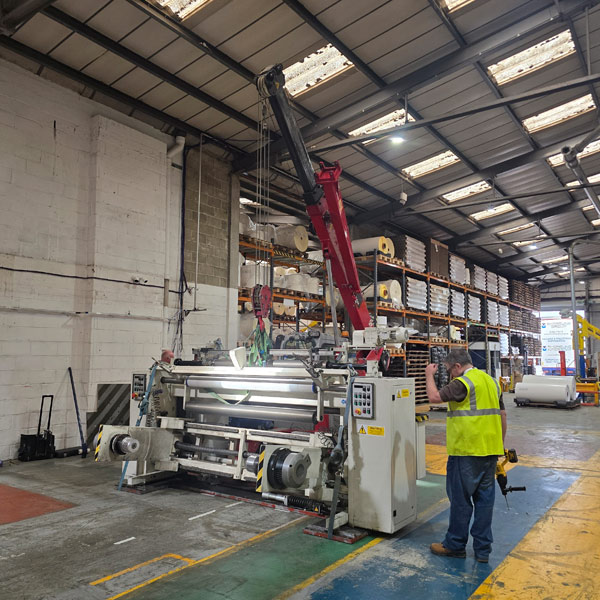
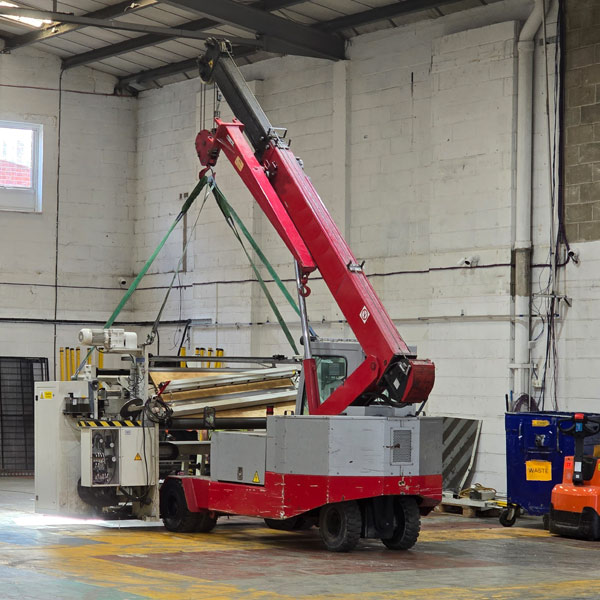
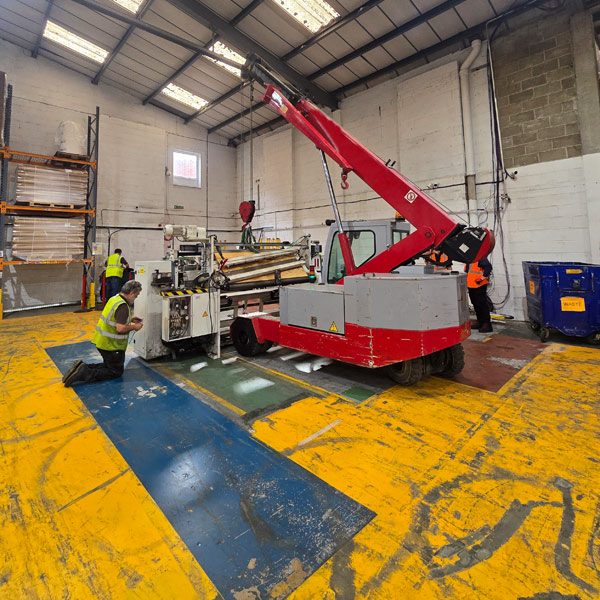
A large pick and carry crane was used to lift each section and transport it across the factory floor to the new position. The oil-filled nature of the machine meant that balance was critical throughout the lift - we used different sized slings on each section, rigged to account for the estimated centre of gravity and to keep the load level and controlled during travel. The crane's pick and carry capability meant we could lift and move in a single operation without needing to set down and re-rig mid-route.
Once both halves were in their new position, we assisted with recombining the machine and setting it down on its new base, ready for the engineers to reconnect services and bring it back into production.
- Calculated weights from steel members and component assessment
- Bespoke lift plan built around estimated weights and centre of gravity
- Pick and carry crane for single-operation lift and transport
- Variable sling configurations to balance oil-filled sections
- Coordinated dismantling and recombination with specialist engineers
Relocated and Recombined in One Day - Production Ready
Both halves of the slitting machine were successfully separated, lifted, transported across the factory floor and recombined in their new position within a single day. The machine sustained zero damage throughout the operation, and the oil-filled systems remained intact and uncompromised.
With the machine set down and aligned in its new location, the engineers were able to begin reconnecting services immediately. The tight one-day turnaround meant production downtime was kept to an absolute minimum - exactly what was needed on an active manufacturing line where every hour of stoppage has a direct cost.
Gallery
Got a Machine to Move?
No lifting data? No problem. Tell us what it is and where it needs to go — we'll work out the rest.
Start Your Enquiry Prefer to talk? Call 01285 741 150